
.gif)

 O'zbekcha
 Русский
 English
 中文
中文

History of the University
The current Gulistan State University was founded on the basis of the Syrdarya State Pedagogical Institute (SDPI), which started its work for the first time in 1965. The presence of Uzbek, Kazakh, Russian, and Tajik schools in the ancient, multi-ethnic settlement of Mirzachul, coupled with a severe lack of pedagogues and subject specialists, served as the primary catalyst for establishing a higher education institution in the region. In its first year, 400 students were enrolled in a single faculty (Philology), supported by 5 core departments. Driven by the regional need for qualified staff, divisions for Uzbek, Russian, and Kazakh language and literature, as well as foreign languages, were quickly opened. At the inception, the institute was staffed by 30 teachers, including 5 candidates of science.
In the first decade, the foundations of the institute were firmly established, and new faculties were opened, including Mathematics, Physics, Physical Training, Correspondence Departments, Librarianship, Primary Education, and History. By 1976, the institute had prepared 3,200 specialists for the national economy and the education system, while the number of faculty members with academic degrees grew from 5 to 39. Distinguished scholars such as Anqoboy Kuljonov and Khudoyberdi Doniyorov successfully defended their doctoral dissertations at the institute during this era.
The second decade shifted the focus toward providing advanced technical support to the educational process. Notably, the introduction of a dedicated telecast studio, teaching through technical means, and broadcasting entrance and state examinations on TV screens garnered immense interest not only within the republic but across the former Soviet Union. Structurally, the institution expanded to include the Faculty of Pedagogy, the Faculty of History and Primary Education, and the Department of Biology. The scientific potential also grew significantly, yielding 1 doctoral and 25 candidate dissertations.
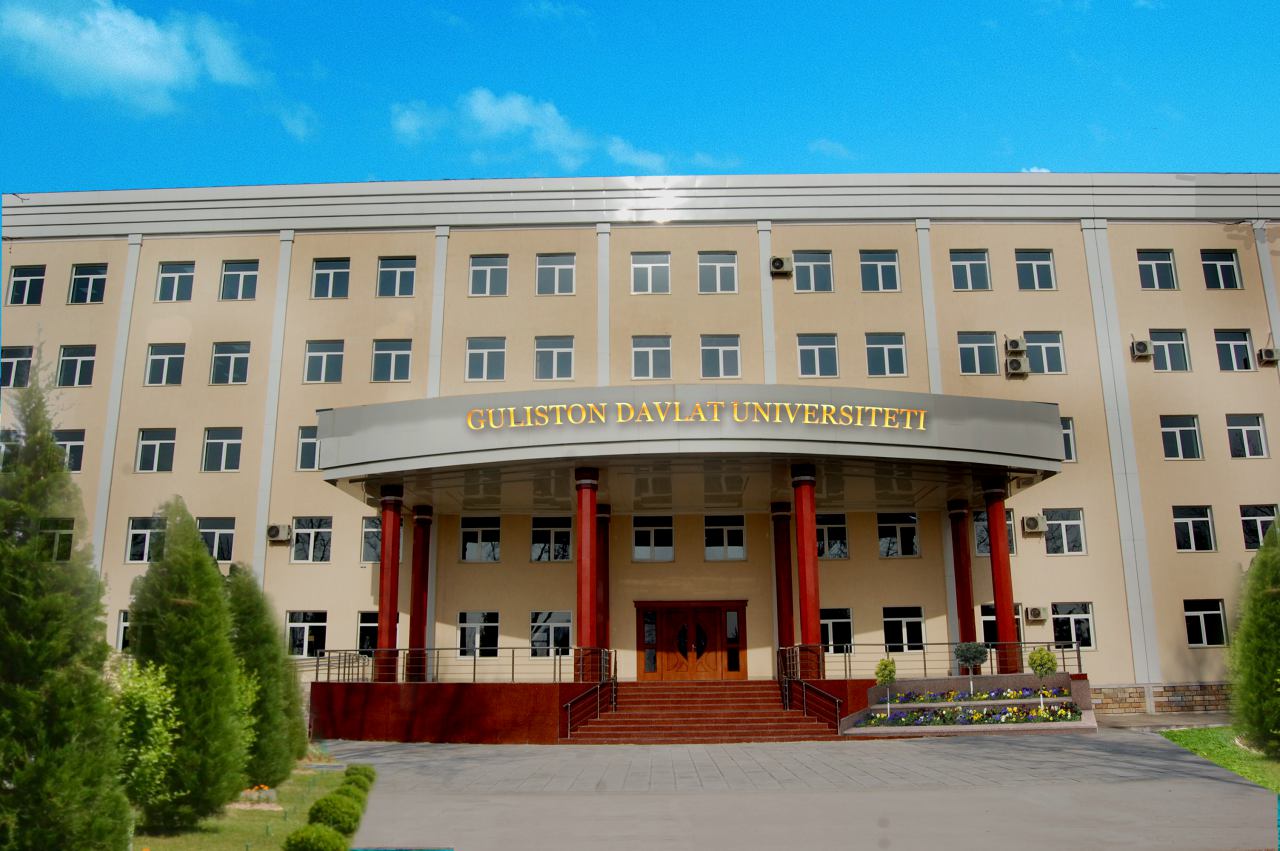
The third decade was marked by the completion of the university's main modern campus in the city of Gulistan. The bright and comfortable study rooms, classrooms equipped with modern equipment, laboratories, and departments were built to a high standard that any well-developed foreign country would admire.
Formation and Modern Structure of the University
Following the independence of our country, paramount attention has been paid to the training of highly qualified cadres and the continuous improvement of the educational process. In February 1992, as part of the national restructuring of higher education, it was decided to establish full-fledged universities in several provinces, including Syrdarya, officially elevating the institute to Gulistan State University.
Over the years, the university has evolved into a major educational cluster. Today, the academic ecosystem thrives on an expansive infrastructure designed to meet global standards. The university attaches great importance to the development of specialized laboratories, mirroring the world's leading educational institutions. The total area of existing laboratories spans 2,008 square meters. In total, 25 specialized study rooms are fully equipped with advanced laboratory equipment, and dedicated language rooms are outfitted with modern lingua-phone systems.
To enable students to leverage digital resources, a local electronic library and extensive internet access have been introduced across the campus. The university features 30 computer classes housing more than 700 computers, out of which 400 are directly connected to the high-speed internet. Furthermore, the database of the Information Resource Center contains over 4,000 e-books and manuals. Students enjoy seamless access to crucial academic information, textbooks, lecture texts, and learning guides directly through the official university website.
Modern Statistical Indicators
Through steady development and institutional expansion, Gulistan State University has significantly amplified its capacity. The contemporary statistical breakdown of the student body is as follows:
Total Number of Students: 14,344
Distribution by Mode of Study:
Full-time Education: 7,534 students
Correspondence (Part-time) Education: 5,875 students
Evening Education: 342 students
Distance Learning: 239 students
Master's Degree Programs: 354 students
Student Distribution by Gender:
Male Students: 5,922
Female Students: 8,422
Scientific Potential and International Cooperation
The scientific vitality of the university remains robust. Every year, approximately 250 scientific articles (including 30 published abroad), 5 monographs, 4 textbooks, and 512 methodical manuals are published by university scientists. Gulistan State University maintains a strong position in the higher education system of the Republic of Uzbekistan, a standing driven by the wide range of active research initiatives. Specialized divisions—including the academic department, marketing department, and the international relations department—work in unison to increase the effectiveness of scientific research and integrate international experience.
International grants from programs such as Tempus and ITEC have historically played a vital role in shaping the university's global integration. Today, the university maintains close, active links with prestigious international institutions and organizations, including IWMI, ICARDA, and JIRCAS. Furthermore, the university has established strong bilateral partnerships with leading universities across the CIS countries, including Lomonosov Moscow State University, St. Petersburg State University, Kemerovo State University, Stavropol State University, and Saratov State University.
Share on social networks
Recent Posts