Education Quality Control Unit
Head of Education Quality Control Department: Matrasulov Bakhodir Erbutayevich
Reception Days: Monday-Friday 14:00-16:00
Russian, English languages
(97) 155-25-98
bahodirm@mail.ru
1993-1998 - Student of Gulistan State University
1998-2002 - Lecturer at the Department of Accounting and Audit, Gulistan State University
2002-2006 - Lecturer at the Department of Economic Theory, Gulistan State University
2003-2011 - Senior Lecturer at the Department of General Economics, Gulistan State University
2011-2019 - Senior Lecturer at the Department of Economics, Gulistan State University
2019-2025 - Head of Education Quality Control Department, Gulistan State University
2025 - Present - Head of Education Quality Control Department, Gulistan State University

Chief Specialist of the Education Quality Control Department: Sidikov Farrukh Jumanazar ugli
Russian language
(94) 583-23-93
farruxsidiqov1993@gmail.com
2021-2023 - Master's student at Gulistan State University in the field of theory and methodology of teaching and upbringing (primary education)
2021-2022 - Primary school teacher at Secondary School No. 50 of Bayaut district, Syrdarya region
2022-2022 - Leading specialist at Secondary School No. 50 of Bayaut district, Syrdarya region
2022-2023 - Primary school teacher at Secondary School No. 50 of Bayaut district, Syrdarya region
2023-2025 - Chief Specialist of the Education Quality Control Department, Gulistan State University
2025 - Present - Chief Specialist of the Education Quality Control Department, Gulistan State University

Chief Specialist of the Education Quality Control Department: Quvondikov Mukhriddin Khamza ugli
Russian language
(99) 989-56-14
muxriddinquvondiqov4@gmail.com
2017-2021 – Student of Gulistan State University
2021-2022 – Driver at "Syrdarya Water Supply" JSC
2021-2023 – Master's student at Uzbekistan State University of Physical Culture and Sports
2022-2023 – Locksmith for emergency repair works at "Syrdarya Water Supply" JSC
2022-2023 – Coach at Syrdarya Regional Specialized Sports School of Combat Arts
2025-2025 – Coach at Mirzabad District Sports School
2025 – Present – Chief Specialist of the Education Quality Control Department, Gulistan State University
Guliston State University
Education Quality Control
Department
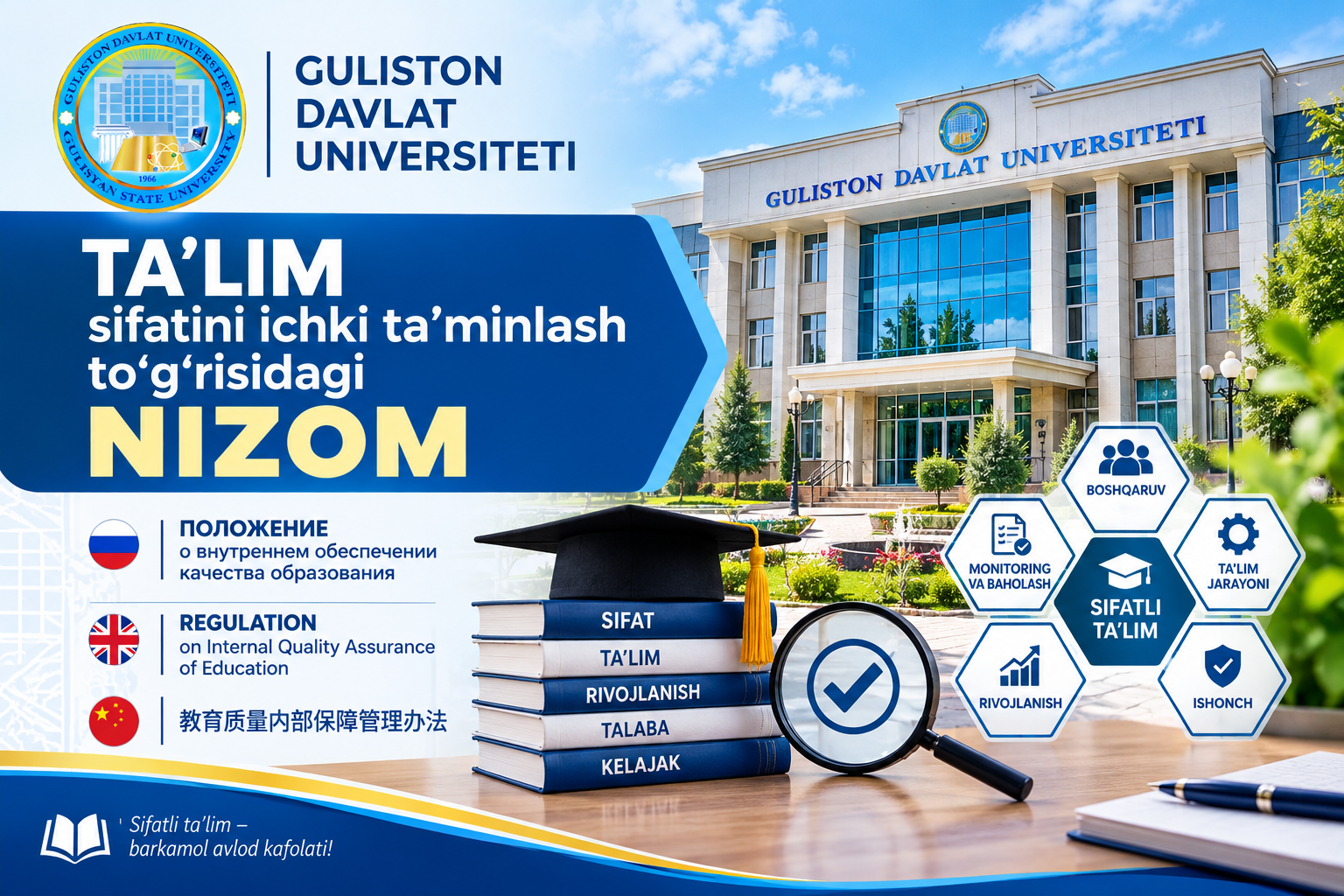
REGULATIONS
Chapter 1. General
Provisions
1. These Regulations have been developed in
accordance with Resolution No. 275 of the President of the Republic of
Uzbekistan dated September 8, 2025 "On the organization of the activities
of the National Agency for Quality Assurance in Education under the
Administration of the President of the Republic of Uzbekistan" and
establish the procedures for organizing the activities of the Education Quality
Control Department within Guliston State University.
2. The Head of the Department and its staff are
appointed to and dismissed from their positions in coordination with the Head
of the National Agency for Quality Assurance in Education under the Administration
of the President of the Republic of Uzbekistan. Appointments to and dismissals
from these positions are formalized by the order of the university rector in
accordance with labor legislation (based on the requirements of the Labor Code
of the Republic of Uzbekistan).
3. The activities of the Department are organized
in accordance with the Constitution of the Republic of Uzbekistan, the Law of
the Republic of Uzbekistan "On Education," resolutions of the
chambers of the Oliy Majlis of the Republic of Uzbekistan, decrees, resolutions
and orders of the President of the Republic of Uzbekistan, resolutions and
orders of the Cabinet of Ministers of the Republic of Uzbekistan, the Ministry
of Higher Education, Science and Innovation of the Republic of Uzbekistan
(hereinafter referred to as the Ministry), orders and legal instructions of the
Agency and the university rector, as well as these Regulations on the
Department.
At the beginning of the academic year, internal
attestation and education quality work are carried out based on the
"Roadmap" developed by the Department and approved by the university
rector and the Agency.
Chapter 2. Main Tasks and
Functions of the Department
4. The main tasks of the Department consist of the
following:
• Conducting internal assessment of
staff retraining and professional development at the educational institution;
• Analyzing the availability and
mutual compliance of state educational standards (SES), qualification
requirements, curricula and subject programs, working curricula and working
programs of subjects for educational directions and specialties;
• Analyzing the compliance of
qualification requirements, curricula and programs with professional standards
and labor market requirements for training competitive personnel;
• Providing methodological
recommendations on forming a culture of education quality in the educational
organization, improving internal quality control criteria and procedures, and
ensuring their effective implementation;
• Developing and improving criteria
and methods for assessing education quality, taking into account international
standards and advanced foreign practices;
• Participating as observers in
student knowledge assessment processes;
• Studying whether student knowledge
control and assessment processes are conducted on the basis of impartiality and
transparency;
• Participating in optimizing course
schedules formed by university faculties;
• Monitoring student attendance and
faculty members' approach to classes;
• Studying the fair distribution of
teaching loads among faculty members;
• Studying the involvement of
qualified specialists from production (practice) for teaching;
• Studying and analyzing whether
independent learning is organized at the required level;
• Reviewing documents of final state
attestation commissions to study the knowledge level of graduates;
• Organizing internal attestation of
the university and submitting internal attestation results and information on
factors negatively affecting education quality to the university rector and the
Agency;
• Monitoring the status of indicators
determining education quality, providing recommendations to the university
rector on identified problems and deficiencies;
• Analyzing the effectiveness of using
modern methods and techniques in the process of faculty professional development
to improve education quality, analyzing the inclusion of subject innovations in
programs;
• Conducting scientific and practical
research and surveys to study the effectiveness of measures aimed at ensuring
education quality in educational organizations;
• Analyzing the state of the material
and technical base of the educational process, providing recommendations for
its development and improvement;
• Monitoring the organization of
student internships taking into account educational directions and specialties
at the university and controlling its effectiveness;
• Participating in processes related
to determining, evaluating, attesting university ratings and studying education
quality;
• Participating in social surveys
conducted among faculty members and personnel consumers at the university to
study the social environment, personnel training and education quality,
developing recommendations based on results;
• Participating in analyzing
graduates' admission to the next stage of education or employment;
• Forming a database of internal
public experts at the university and regularly conducting seminar sessions with
them within the scope of assigned tasks;
• Providing recommendations on
expanding integration cooperation between the educational process and
production, innovative ideas, developments and technologies;
• Publishing annual reports with the
participation of the public and stakeholders to ensure openness and
transparency of activities in assessing education quality;
• Analyzing the achievement of target
indicators and results specified in state programs and strategies in the field
of education and developing recommendations;
• Developing proposals for developing
the education sector and research activities, improving legislation in this
area and promoting promising initiatives;
• Submitting relevant recommendations
to university leadership based on the results of studying the state of
education quality.
5. The Department performs the following functions
to fulfill its assigned tasks:
For conducting external assessment in secondary
specialized, vocational, higher and post-higher education, as well as staff
retraining and professional development, and competency assessment sectors,
regardless of administrative affiliation, ownership and organizational-legal
form:
• Analyzes the educational
organization's compliance with established normative-legal documents, norms and
rules;
• Conducts special and comprehensive
state accreditation of educational organizations;
• Maintains its national rating based
on comparative analysis of the quality of educational and research processes at
the educational organization;
• Evaluates the compliance of
educational programs with professional standards and established
qualifications;
• Analyzes whether a fair and
supportive environment has been created for all students by ensuring equality
and inclusiveness in the educational organization;
• Establishes integration processes
with relevant platforms of state agencies to increase the efficiency of data
exchange in accreditation-related information systems;
For providing methodological recommendations on
forming a culture of education quality in educational organizations, improving
internal quality control criteria and procedures, and ensuring their effective
implementation:
• Provides methodological assistance
to educational organizations in forming quality culture and ensuring education
quality;
• Participates in developing criteria,
indicators and guidelines related to ensuring internal quality based on
international practices;
• Develops recommendations for
preventing corruption situations in education and science, eliminating their
causes and conditions, and avoiding conflicts of interest;
For developing and improving criteria and
methods for assessing education quality, taking into account international
standards and advanced foreign practices:
• Studies advanced foreign practices
and develops and continuously improves criteria and methods for assessing
national education quality based on them;
• Involves local and foreign experts
in updating education quality assessment criteria and methods;
• Continuously improves accreditation
criteria in accordance with the national qualifications system;
For conducting scientific and practical
research and surveys to study the effectiveness of measures aimed at ensuring
education quality in educational organizations:
• Conducts sociological and other
surveys to study the effectiveness of measures aimed at ensuring education
quality in educational organizations;
For publishing annual reports with the
participation of the public and stakeholders to ensure openness and
transparency of activities in assessing education quality:
• Takes measures to digitalize
processes related to education quality and accreditation;
• Conducts regional employer surveys
to assess the knowledge and skills of educational organization graduates and
study their integration into the labor market;
• Conducts student surveys aimed at
studying students' opinions on education quality, as well as surveys aimed at
studying the public's opinions on education quality;
• Develops recommendations in cooperation
with regional executive authorities in the field of education to strengthen
public oversight of educational system activities, ensure transparency and
apply corporate governance methods;
For analyzing the achievement of target
indicators and results specified in state programs and strategies in the field
of education and developing recommendations:
• Takes measures in cooperation with
regional executive authorities in the field of education to find solutions to
the most urgent issues and problems in the system, broadly involving the
public, leading foreign experts, consultants and advisors;
• Reviews all draft normative-legal
documents in the fields of staff retraining and professional development,
competency assessment, and expresses its proposals and objections;
• Develops promising initiatives
related to the field of education based on proposals from education service
consumers, scientific-pedagogical community, state agencies and organizations
in cooperation with regional executive authorities in the field of education;
For developing proposals for developing the
education sector and research activities and improving legislation in this
area, and promoting promising initiatives:
• Systematically studies, analyzes
current legislation in the field of education and science at the educational
institution, and prepares recommendations for its improvement;
6. The Department has the right to obtain
necessary information and materials from university structural units within the
scope of tasks and functions assigned to it for the purpose of carrying out its
assigned tasks and functions based on the principles of legality, impartiality,
accountability, openness and transparency.
Chapter 3. Rights and
Obligations of the Department
7. In carrying out its assigned tasks and functions,
the Department has the following rights:
• To obtain necessary information and
materials within the scope of its duties from university structural units for
performing the tasks and functions assigned to the Department;
• To submit other documents related to
performing the tasks and functions assigned to the Department in the
established manner;
• To freely use information systems
for managing the educational processes of the educational institution (HEMIS)
and the unified electronic system for coordinating post-higher education;
• To submit instructions to the
educational organization on improving education quality that must be reviewed;
• To conclude cooperation agreements
with international and non-governmental organizations on issues of ensuring
education quality, accreditation, ratings and other matters;
• To conduct studies, monitoring and
surveys related to education quality at the educational organization;
• To submit a representation to the
educational organization based on the "risk analysis" system regarding
violations of identified requirements and conditions by the Department, and to
set deadlines for eliminating deficiencies;
• To implement standards, criteria and
indicators related to ensuring education quality in practice;
• To form expert commissions and
working groups with the participation of local experts;
• To formulate technical assignments
for expert commissions and working groups to deeply analyze, evaluate and
develop proposals on the current state in the field of education, and to
develop "roadmaps" for reforming the relevant education sector
involving consulting companies;
• To provide paid services not
prohibited by legislation;
• To provide consulting and
expert-analytical services in its areas of activity, to establish
organizational-legal structures for carrying out these tasks;
• To address issues related to
improving education quality and educational processes at educational
organizations jointly with relevant state agencies.
8. In accordance with legislative documents, as
well as based on assignments from the President of the Republic of Uzbekistan
and the Administration of the President of the Republic of Uzbekistan, the
Department may also have other rights.
9. The Department is obligated to:
• Perform assigned tasks with quality
and on time;
• Conduct state accreditation in
strict compliance with legislative requirements;
• Ensure transparency during
accreditation processes and publicly announcing their results;
• Organize complaint and appeal
procedures for cases of dissatisfaction with accreditation decisions;
• Ensure executive discipline.
Share on social networks

.gif)


O'zbekcha
Русский
English
中文