
.gif)


 O'zbekcha
 Русский
 English
 中文
中文

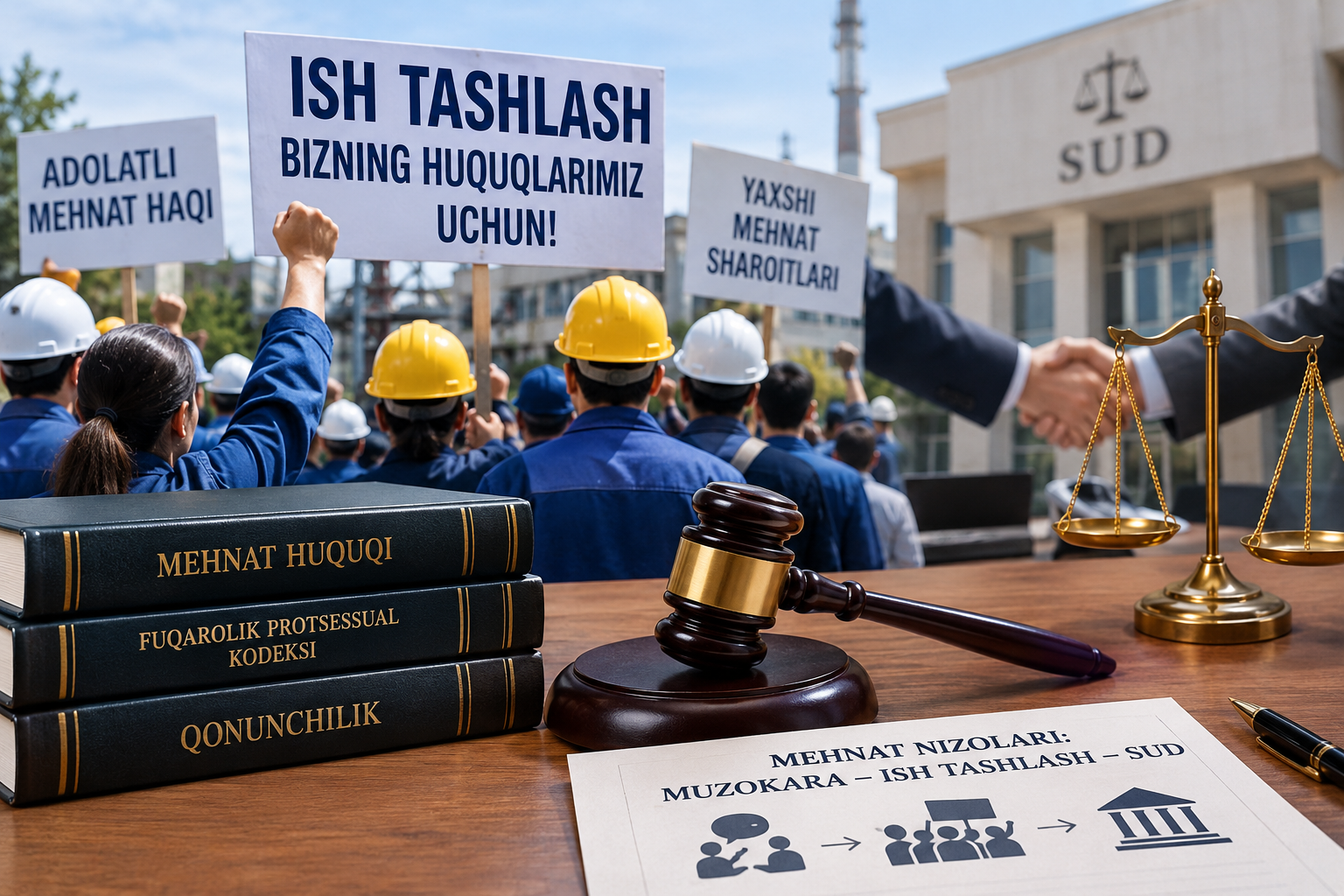
Strike Action as a Legal Means of Resolving Labor Disputes
Labor relations play an important role in ensuring socio-economic stability in society. Ensuring decent working conditions for employees, fair remuneration for their work, and the protection of their labor rights and legitimate interests are among the important directions of state policy in the field of labor.
At the same time, the interests of employees and employers do not always coincide in labor relations. In such cases, labor disputes may arise between the parties.
The peaceful resolution of labor disputes primarily involves negotiations between the parties and reaching a mutually acceptable solution. However, in some cases, it may not be possible to resolve employees’ collective demands through other means. In such situations, the institution of strike action becomes important as one of the means of collectively protecting employees’ rights and legitimate interests.
A strike is one of the collective forms of protecting the labor rights and legitimate interests of employees. First and foremost, it serves as a means aimed at resolving a labor dispute arising between employees and the employer.
The main essence of a strike is the collective temporary refusal by employees to perform their labor duties in order to notify the employer of the need to consider and resolve their demands.
A strike is an important legal institution that enables employees to express and protect their collective interests in labor relations. Its significance lies in the fact that where the possibility of pursuing demands individually is limited, employees have the opportunity to protect their interests collectively. In this respect, a strike is regarded as one of the means of ensuring a balance of interests between employees and the employer.
However, a strike is not merely a means of putting forward employees’ demands; it may also produce certain legal consequences.
In particular, compliance with the procedure and conditions established by law for conducting a strike is of significant importance in determining its legality.
Conversely, a strike conducted without compliance with the prescribed procedure may affect the rights and legitimate interests of employees, the employer and other persons, and may also give rise to legal consequences provided for by law.
The consequences of a strike, on the one hand, may be related to employees putting forward collective demands concerning improved working conditions, remuneration, protection of labor rights or other collective demands, while, on the other hand, it may result in the temporary suspension or restriction of the employer’s activities.
Therefore, when exercising the right to strike, it is important to ensure a balance between the collective interests of employees and the interests of the employer, other employees and society.
Thus, a strike may be regarded not only as a temporary cessation of work, but also as a legal means aimed at resolving labor disputes, protecting the collective interests of employees, and coordinating the interests of the parties in labor relations.
For the purpose of resolving such disputes through judicial proceedings, the Civil Procedure Code establishes a procedure for courts to consider cases concerning the postponement of the starting time of an announced strike, its suspension, or the declaration of a strike as unlawful.
The significance of these provisions is that, while a strike is a form of exercising employees’ collective labor rights, it may also affect the interests of the employer, other employees and, in certain cases, society as a whole.
Therefore, legislation provides for the possibility of judicial review of disputes related to the conduct of strikes.
Where a claim for postponement of the starting time of a strike or for its suspension is aimed at preventing the strike from being conducted for a certain period, a claim seeking to have the strike declared unlawful concerns determining whether the requirements and procedure established by law for conducting the strike have been complied with.
Accordingly, when considering such cases, the court should assess not only the claims and objections of the parties, but also the legal grounds for declaring the strike, compliance with the procedure for conducting it, and the possible legal consequences that may arise as a result of the strike.
D. Burkhanov
Judge of the Court of Syrdarya Region
Share on social networks
Recent Posts